Experimental parameters
| Symbol | Description | Unit |
|---|---|---|
| reactor radius | cm | |
| reactor length | cm | |
| volumetric flow rate | cm3 s–1 | |
| pressure | Torr | |
| temperature | K | |
| diffusion coefficient | cm2 s–1 | |
| molar mass | g mol–1 | |
| time adsorption starts | s | |
| time adsorption ends | s |
Model description
This application allows users to extract parameters of the Langmuir-Hinshelwood mechanism from uptake experiments in a flow reactor. Langmuir-Hinshelwood is a widespread mechanism for heterogeneous uptake and consists of reversible adsorption of gas-phase reactant to a sorptive site ,
followed by irreversible reaction of adsorbate with a reactive site , which produces product and releases a sorptive site :
Radial diffusion in a cylindrical reactor is accounted for by an additional step that precedes sorption:
where the first-order diffusion rate constant is given by . Occupied and unoccupied surface sites are conserved:
Thus, there are 5 unknown parameters that are extracted by this application from experimental uptake curves: , , , , and .
An animation of an uptake experiment with an adsorption and desorption cycle in a coated wall reactor is shown in the video below:
A cylindrical flow reactor with heterogeneous uptake occurring at reactor walls is approximated as a series of continuous stirred tank reactors (CSTRs). For a system of CSTRs, concentration of component X at the outlet of reactor :
where , , and is outlet concentration - the main experimental observable.
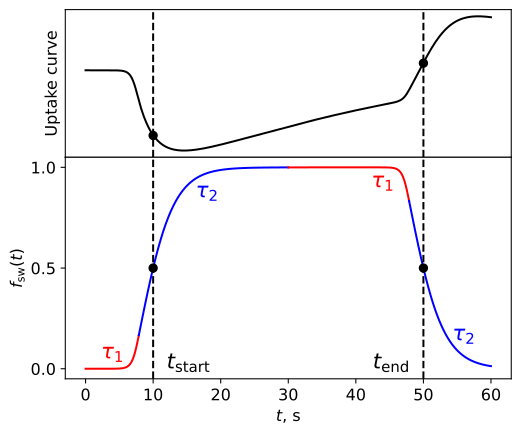
Start and end of exposure in an uptake experiment are simulated by a switching function , which is 0 before and after . The adsorption rate constant is multiplied by , effectively enabling adsorption only between times and . The switching function has two parameters and , which correspond to the sharpness of the start of the transition and of the end of the transition respectively. must be greater than . The switching function is a piecewise function consisting of two sigmoids, combined such that the function and its first derivative are continuous:
The plot below shows an example switching function with , , , and along with an uptake curve produced by it. Note that and correspond to the points in time where the value of the switching function is 0.5, meaning that the adsorption rate constant is downscaled by a factor of two. They do not necessarily correspond to the points where the uptake curve starts changing.
Derived parameters
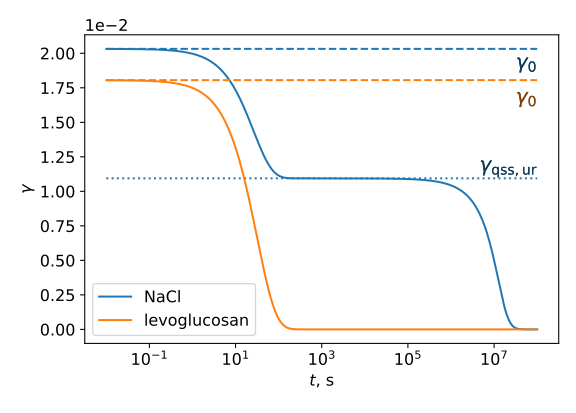
Parameters useful for equilibrium and kinetic environmental modeling can be derived from fitted parameters of the Langmuir-Hinshelwood mechanism. This application automatically calculates several such parameters after a successful fitting run: partitioning constants and and uptake coefficients and . Those parameters are derived and explained below and boxed equations provide their definitions. Plots shown in this section compare values of analytically derived partitioning constants and uptake coefficients against numerically simulated uptake on aerosol particles with diameter of 0.4 μm, number density of 1000 particles cm–3, and gas-phase concentration of HgCl2 of 100 pg m–3. Heterogeneous chemistry parameters shown at the bottom of this page were used in simulations.
Equilibrium model parameters
Used for equilibrium modeling of heterogeneous uptake, surface area-normalized gas-particle partitioning coefficient is defined as the ratio of surface concentration of reversibly adsorbed to gas-phase concentration of the reactant near the surface . Reversible sorption is at equilibrium when . Let us call the state when sorption is at equilibrium the quasi-steady state. It is not necessarily the true steady state, because in the true steady state the surface reaction has gone to completion. But in the quasi-steady state, the reaction may or may not still be ongoing. An analytical expression for at quasi-steady-state can be derived from the rate law for . Let and , then:
The amount adsorbed at quasi-steady-state, , does not depend linearly on the gas-phase concentration, , because the number of available sorptive sites is limited. But at low concentrations, like in the atmosphere, the response of to is approximately linear and is the proportionality constant. We can derive the expression for in terms of Langmuir-Hinshelwood parameters by linearizing the function . Linearization is done by performing a Taylor expansion around and keeping only the first order term. Thus, an expression for in the low coverage limit is obtained:
Now, two proportionality constants can be derived from the low coverage limit of . One is , which gives the amount adsorbed at a point in time when the surface reaction has gone to completion () or when there was no reaction to begin with ():
Another proportionality constant is , which gives the amount adsorbed at a point in time when sorption has equilibrated but the surface reaction has just begun ():
Depending on the lifetime of particles in the atmosphere and on the characteristic timescale of surface reaction under atmospheric conditions, or may be used interchangeably in a model. However, it is important to note that and only predict the surface concentration of adsorbate , not the product of the surface reaction . Concentration of is time-dependent and approaches at steady state independently of gas-phase concentration. So, if particles represented by an equilibrium model have a sufficient lifetime for the surface reaction to run to completion, the model can approximate the total particle-bound phase concentration as in the limit as .
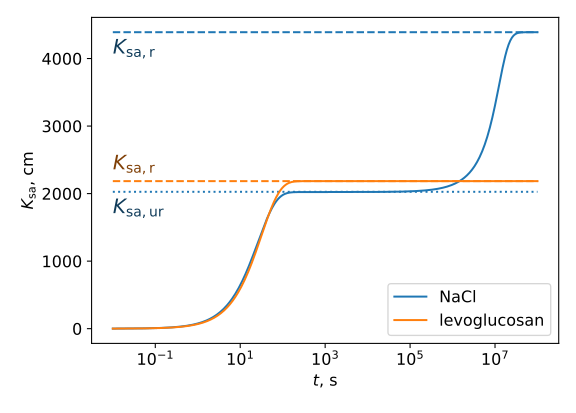
Alternatively, a total partitioning constant which relates the total particle-phase concentration to gas-phase concentration . It requires an assumption about the atmospheric lifetime of a particle and assumes that surface reaction product is produced at a constant rate:
The equation above is valid up until the point in time when all reactive sites get consumed, which is given by:
Kinetic model parameters
Used for kinetic modeling of heterogeneous uptake, the uptake coefficient is defined as the ratio of the net uptake flux of X by the surface to the total thermal collision flux of X with the surface:
where is the mean normal molecular velocity toward a surface:
In a freshly emitted particle, uptake is fastest because none of the sorptive sites have been used yet, and this regime is characterized by initial uptake coefficient , which can be derived by evaluating at :
An expression for uptake coefficient at quasi-steady-state (after sorption has reached equilibrium, but while the reaction is still going) can be derived by evaluating at derived earlier:
depends on gas-phase concentration, but at atmospheric conditions where concentrations are low, it can be approximated as a constant by performing a Taylor expansion of around and keeping the zeroth-order term:
If we further make an assumption that the concentration of product is close to zero, which is a valid assumption for aerosol particles over a large fraction of their lifetime, a unreacted-surface quasi-steady-state uptake coefficient can be derived:
Under atmospheric conditions, reversible sorption equilibrates within minutes, while the surface reaction often proceeds for days with relatively low product coverage. Thus, one way to model heterogeneous uptake in an aerosol model is to use to account for sorption in an equilibrium manner and to simulate uptake by the surface reaction for the rest of the lifetime of the particle in a kinetic manner. If a particle is non-reactive, then uptake on it can be simulated in an equilibrium manner with without the need for uptake coefficients.
Convergence parameter of the CSTR chain
The solution of a system of chained CSTR reactors approaches the solution of a flow reactor as the number of reactors approaches infinity. To determine if the selected number of reactors is sufficient, the ratio of Damkohler number to the number of reactors is used:
The closer is to zero, the better. We found that the best tradeoff between performance and accuracy is achieved when is slightly less than 0.15.
Estimation of uncertainties
Standard errors are estimated from the parameter variance matrix . Standard error of parameter :
The parameter variance matrix is calculated from the variance of the noise and Jacobian :
Variance of the noise of experimental data is calculated relative to the best-fit solution:
where is the number of experimental points in the dataset and is the sum of squared residuals at parameter vector .
Input file format
Input files must be in comma-separated values (CSV) format. The file must contain two columns. The first column is time in seconds and the second column is the concentration of gas-phase reagent X in cm-3. The first row is assumed to contain column headers and is skipped by the parser. Time points must be equally spaced.
Experimental conditions and model parameters for example datasets
Experimental inputs
| Parameter | Value | Unit |
|---|---|---|
| 0.78 | cm | |
| 2 | cm | |
| 2.493 | cm3 s–1 | |
| 1.965 | Torr | |
| 300 | K | |
| 0.431 | cm2 s–1 | |
| 271.52 | g mol–1 | |
| 267.24 | s | |
| 543.78 | s | |
| 1.0 | s | |
| 2.5 | s |
Fitted parameters
| Parameter | Value | Unit |
|---|---|---|
| (2.1 ± 0.1) × 10–12 | cm3 s–1 | |
| (1.77 ± 0.08) × 10–2 | s–1 | |
| (2.4 ± 0.2) × 10–16 | cm2 s–1 | |
| (3.7 ± 0.1) × 1013 | cm–2 | |
| (8.6 ± 0.2) × 1013 | cm–2 |
Download dataset: nacl.csv
Experimental inputs
| Parameter | Value | Unit |
|---|---|---|
| 0.78 | cm | |
| 5 | cm | |
| 2.368 | cm3 s–1 | |
| 1.924 | Torr | |
| 300 | K | |
| 0.431 | cm2 s–1 | |
| 271.52 | g mol–1 | |
| 157.88 | s | |
| 293.28 | s | |
| 1.0 | s | |
| 8.5 | s |
Fitted parameters
| Parameter | Value | Unit |
|---|---|---|
| (5.9 ± 0.2) × 10–12 | cm3 s–1 | |
| (3.16 ± 0.05) × 10–2 | s–1 | |
| 0 | cm2 s–1 | |
| (1.17 ± 0.03) × 1013 | cm–2 | |
| 0 | cm–2 |
Download dataset: levoglucosan.csv
Source code availability
The back-end engine of this web application, which solves the system of ODEs and performs fitting, is written in C++ and is open source. The C++ code can also be compiled into a standalone command-line executable. The code uses the CVODE solver from the SUNDIALS suite to solve the ODEs and Ceres solver to fit the solution.